Text, meta-text, and ‘canon’: (Re)tracing the Nazgûl (and their horses) from September 22 to October 20, 3018
Where are the Nazgûl and what are they doing? How absences affect the text.
The text of the Lord of the Rings (LOTR) presents many challenges for the annotation team. Generally our focus is on annotating the latest edition of the text as published, with a focus on the mainline of the narrative, according to the frameworks within the text itself, as well as the research questions that the annotations hope to answer. However, Tolkien had in his mind and in his notes a complete, living world that also operates around the mainline of the story. All chapters depend to some extent on other actions and events occurring outside of the text to help drive the story.
For example, the Nazgûl’s quest for the Ring from the point when they cross into the Shire at Sarn Ford after driving off the Dúnedain to the culmination of their hunt at the Fords of Bruinen is told primarily from the prey’s point of view where they are periodically terrorized by rumours and tellings (e.g., ‘off-screen’ conversations between the Gaffer and Khamûl and Farmer Maggot and Khamûl and his companion) or by direct attacks by the Nazgûl on the mainline of the narrative. However, it is clear that the Nazgûl are omnipresent if not always proximate (nearby as either stated or implied by a careful reading of the text) or not considered as having arrived (flagged as an arrival by the annotator) on the mainline of the narrative. The Nazgûl’s ‘off-screen’ activities have consequences for how we annotate the text, and therefore require annotators to examine secondary or primary sources of evidence while acknowledging that we are making educated suppositions.
Addressing absences through secondary and primary sources
The closer the proximity of these sources to Tolkien the better. Examples of these sources can include published works that draw on unpublished texts, art, and cartography, such as those prepared by Christopher Tolkien or Humphrey Carpenter like Unfinished Tales (UT), The History of Middle-Earth (HoME), The Silmarillion (Silm), or The Letters of J. R. R. Tolkien (Letters); or works such as The Lord of the Rings: A Reader’s Companion [RC] (2014) and The J. R. R. Tolkien Companion and Guide: Reader’s Guide Parts 1 and 2 [CG: RG I-II] (2017) by Wayne G. Hammond and Christina Scull, which also publish excerpts from and paraphrase Tolkien’s unpublished archives and manuscripts. Although we expand out beyond the text of LOTR, we then take that information, fold it into our thought processes, and use it in subsequent annotation passes to see if it reasonably informs questions like which characters – named or unnamed, individuals or groups, two-legged or four legged – might be present in each chunk of text. These are subjects of much debate during our meetings and in our Discord chats.
Hammond and Scull
In order to trace and re-trace the paths of the Nazgûl, we were alerted to manuscripts documenting their movements in UT “The Hunt for the Ring” and in its footnote 1; there Christopher Tolkien mentions yet another text: “From notes recounting in detail the movements of the Black Riders in the Shire [...].” But the real key was Hammond and Scull’s RC, which includes as its frontispiece an illustrated plate showing Tolkien’s synoptic time-scheme for March 1419 (Shire Reckoning). They write:
Notable among these materials [the J. R. R. Tolkien Collection Manuscripts at Marquette University1] is a series of time-schemes, especially those in Marquette MSS Series 4, Box 2, Folder 18, with which Tolkien kept track of the whereabouts and actions of his various characters, and the plot outlines and time-schemes in Marquette MSS 4/2 comprising The Hunt for the Ring (some of which is published in Unfinished Tales). (Hammond and Scull, RC xiii)
In addition, Hammond and Scull provide a considerable amount of the text from a critical manuscript prepared by Tolkien for inclusion in the appendices to the LOTR, which were excluded due to space considerations: MSS 4/2/36 “The Hunt for the Ring - Time Scheme: Black Riders, Holograph, 10/18.” Although, it is impossible to treat the information in the unpublished manuscriptions as ‘canonical’ as the published text of LOTR, Hammond and Scull state:
And in the second half of 1954 and early 1955 he wrote additional material for the Appendices, but had to omit most of this for lack of space: it included the works now known as The Quest of Erebor [MSS 4/2/26–30] and The Hunt for the Ring [MSS 4/2/27–37] , parts of which (in different versions) were eventually published in Unfinished Tales (1980). (Hammond and Scull, RC xxxiv)
It is reasonable to assume therefore that MSS 4/2/36 was developed to underpin the admittedly competing manuscript narrative versions for the “The Hunt for the Ring.” The challenge for us though was that although Hammond and Scull published a large part of MSS 4/2/36 in RC, “it was published in sections deemed appropriate to the development of the story (see pp. 97, 99, 116, 145, 164–5, 166, 166–7, 180–1, 194, 195–6, 262–3) and adapted to make it more comprehensible in this form, with descriptive phrases substituted for the letters ABCDEFGHI used by Tolkien to identify the individual Black Riders.” (Hammond and Scull, CG: RG I 559)
Cipher and Clues
Although I am a working archivist and I would much to prefer to work with the original MSS, it was clear that if we could apply the ABCDEFGHI key correctly to several sufficiently detailed paraphrases from Hammond and Scull, then it would be possible to use their paraphrases in RC and a careful reading of the passages where the Nazgûl are present, proximate, or mentioned to map out their movements across the chapters “Three is Company” to “Flight to the Ford” (i.e., September 22–October 18, 3018).
The author thanks Manuscripts Archivist William Fliss at the John P. Raynor, S.J. Library at Marquette University for supplying the cipher identifying Nazgûl ABCDEFGHI based on MSS 4/2/36, which he applied to several passages (only) in RC.2 This permitted me to build up an overview of their movements in a spreadsheet that cross-referenced dates, each Nazgûl and their relationships to each other (for example there are two loose groupings – ‘Morgul’ and ‘Dol Goldur’ – initially, and Khamûl (E) and his companion (F) mostly stick together until October 4, 3018, etc.), locations and landmarks, passages from RC as well as UT, and references in rimbë, the Digital Tolkien Project’s annotation platform. Here is a brief example of the marked up text from page 97 of RC concerning the assault on Sarn Ford on September 22, 3018:
[...] (Marquette MSS 4/2/36). It begins by noting that after the Black Riders overcame the Rangers guarding Sarn Ford, four of them, including the leader, the Witch-king, turned eastward [...] and five, including Khamûl, formerly the commander of Dol Guldur, entered the Shire and divided:
[One] (G) keeps to the east, passing northwards towards the Marish and Bridge. [One] (H) takes road leading northwest to Michel Delving, and [another] (I) goes with him, but there ?fares on and traverses the North Farthing. [The other two] (E and F) go through the central Shire, until they reach the East Road, probably near the Three-Farthing Stone. ([These] (E and F) were probably Khamûl and his companion, from Dol Guldur; and [Khamûl] (E) [is] the most ready of all ( save [the Witch-king] (A)) to perceive the presence of the Ring, but also the one whose power was most confused and diminished by sunlight). Drawn by the Ring [Khamûl] (E) goes to Hobbiton which he reaches at evening on Fri. Sep. 23rd. [His companion] (F) keeps an eye on the East Road and Stock Road, lurking probably between the two, just south of Whitfurrows. [Khamûl] (E) just misses Frodo, and misled by the Gaffers [sic] starts out east again.
Not an end but a means
By November 2, 2025, I was ready to share the spreadsheet with the rest of the annotation team, since several of us were responsible for different chapters through which the Nazgûl’s hunt for the Ring flowed. Our primary concern was understanding how we could compare and use the information from a meta-text of a primary source that was not included in LOTR to enhance our annotation of its text. Would the meta information align with clues in the text to give us confidence that information possibly meant for inclusion in the published appendices gave us a better picture about what is happening in the text?
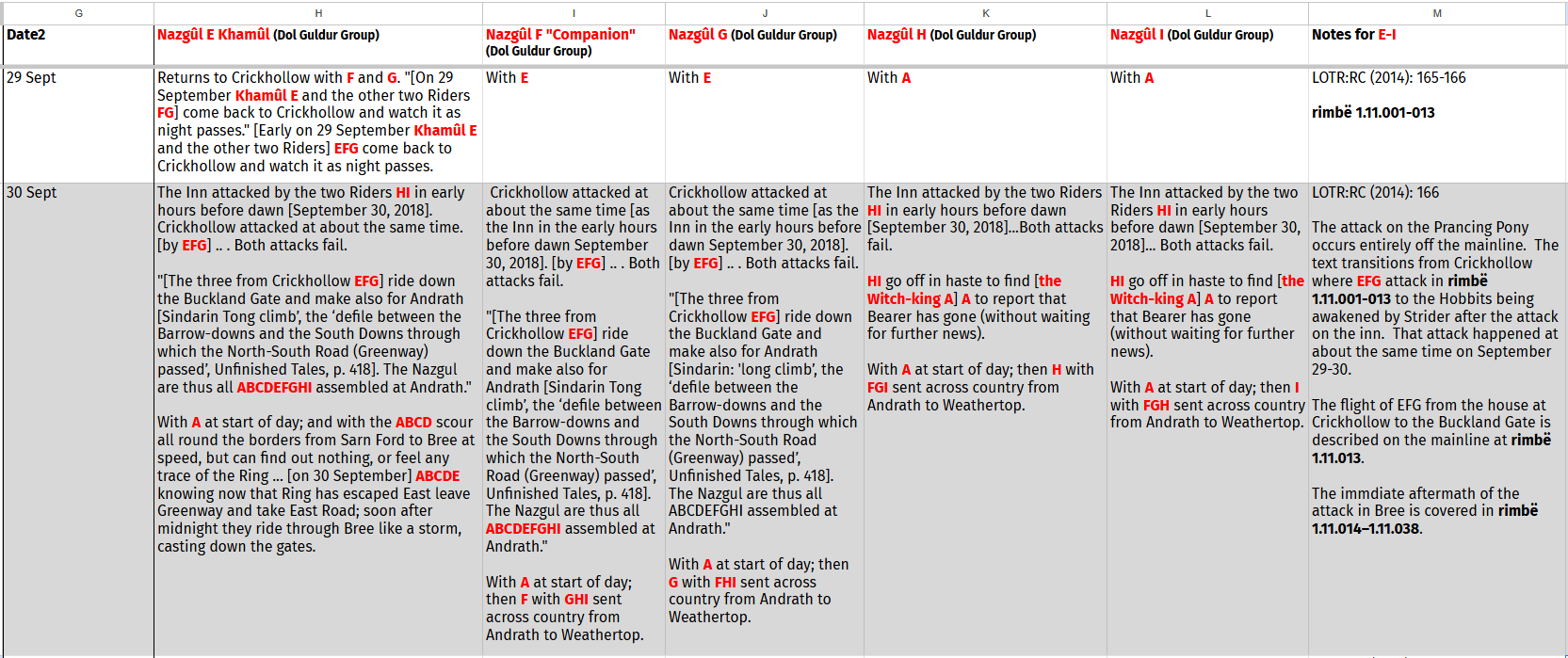
Two things are clear from the image of the tracking spreadsheet given above for September 29–30, 3018. First, we can verify the numbers of the Nazgûl and the presence of their horses and give a bit more detail in the annotation. Thus in chunk 1.11.002, we read “The night deepened. There came the soft sound of horses led with stealth along the lane. Outside the gate they stopped, and three black figures entered, like shades of night creeping across the ground. One went to the door [...].” This gives us a character annotation for this chunk that looks like Khamûl EA, Fredegar BolgerD, Nazgûl FA, Nazgûl GA, Nazgûl G’s horseP, Khamûl E’s horseP, and Nazgûl F’s horseP.3 Second, thanks to the manuscript sources as paraphrased by Hammond and Scull, we can see how much action does not occur directly in the text. Tolkien drives the narrative and creates tension not only through his descriptive powers, but through a masterful talent for leaving his characters and his readers in the dark when it serves the story.
Conclusion
Annotating The Lord of the Rings requires looking beyond the published narrative to track ‘off-screen’ or only partially described events that influence the how the annotation team does its work. By cross-referencing secondary and primary sources in this example, the team can map the individual movements of the Nazgûl and apply or verify more precise character tags (including the horses!) to specific passages like the attack on house at Crickhollow or later at Weathertop4 where the text and the meta-texts describe a long approach and a much different encounter than that given in the movie version of The Fellowship of the Ring. Ultimately, this work is in service of creating rich annotations that can generate data/ data-sets and data visualizations that will be provided by this site. These will answer research questions, spark new ways of knowing and lines of inquiry, and support novel means of using and understanding Tolkien’s rich texts.
-
“J.R.R. Tolkien Collection Manuscripts, circa 1930–1955; Printed Literature & Secondary Works, 1910–.” Raynor Memorial Libraries, Marquette University, www.marquette.edu/library/archives/Mss/JRRT/. Accessed 15 Sept. 2026. Note that Christopher Tolkien donated this material as the fourth Installment (MSS-4) of additional LOTR MSS on August 13, 1997, after he had used the materials for UT. ↩
-
William Fliss, email to Ken Hernden, October 29, 2025, RE: Tolkien MSS 4/2/36 “The Hunt for the Ring.” ↩
-
A = arrival, D = departure, P = proximate. We know that Fredegar Bolger departed in this chunk based on textual evidence in chunk
1.11.008, “As soon as he [Fredegar] saw the dark shapes creep from the garden, he knew that he must run for it, or perish. And run he did, out of the back door, through the garden, [...].” ↩ -
In “A Knife in the Dark” at chunk
1.11.108when Frodo and company on Weathertop see that, “[...] two black specks were moving slowly along it, going westward; and looking again he saw that three others were creeping eastward to meet them,” the meta-texts permit a much richer data set then ‘un-known Nazgûl’ or ‘group of un-named Nazgûl’. Instead we get: Frodo, Merry, Aragorn, Khamûl EP, Witch-king of Angmar AP, Nazgûl GP, Nazgûl HP, Nazgûl IP, Nazgûl G’s horseP, Nazgûl H’s horseP, Nazgûl I’s horseP, Witch-king of Angmar A’s horseP, and Khamûl E’s horseP. ↩
Explore the movements of the Nazgûl
Follow the riders in the interactive viewer, starting with September 29–30, 3018.
Open the interactive viewer